Wednesday, July 28, 2010

Wildflower Wednesday--Nodding Wild Onion


Nodding wild onion (Allium cernuum) is a dainty member of the onion family that blooms with icy pink-nearly white clusters of dangling flowers.


These plants were passalongs from Mr. McGregor's Daughter, and they are thriving in part sun. They're mixed with a number of other prairie natives, including rattlesnake master (Eryngium yuccifolium), yellow coneflower (Ratbida pinnata), Short's aster (A. shortii), wild hyacinth (Camassia scilloides) and 'Twilite' baptisias. As this is a new border, most of those have finished blooming or are gearing up for next year.

For more wildflowers this Wednesday, see Gail at Clay and Limestone!

Monday, July 26, 2010

Long Time, No Blog

Well, I have been out of the loop lately! I missed Buffa10 and July Bloom Day, although I have enjoyed everyone else's posts on those topics. My reasons for this are work and life, but nevertheless the garden is carrying along quite well in our hot, sunny summer weather!

The Joe-Pye Weed (Eupatorium maculatum) is in full flower, and I'm happy to report others are enjoying it besides me.


The vegetable garden is a bit of a mixed bag. The tomatoes are growing splendidly at this point, no doubt encouraged by the weather.


I have only three--Amish Paste, Cherokee Purple and Black Krim--but all are bearing lots of as-yet-unripened fruit.


Cherokee Purple is winning the race for first tomato to ripen.

All the peppers are similarly thriving, such as these Thai chili peppers in the container 'o fire (which also includes a jalepeno and habanero).


But what's wrong with my squashes (and cucumbers) again?! All I have are these:


Lots of pretty flowers, but no squash (or zucchini or cucumbers). This cucumber vine is threatening to take over the whole bed, and I had to cut its tendrils off the tomatoes, yet no veggies!!


I have borage planted nearby to draw pollinators, and there's more near the tomatoes (which have obviously been pollinated). There are bees, wasps and flying bugs of all kinds around this garden constantly, so what's going on?

Right next door, the rain garden is coming into its own this year. The cardinal flowers (Lobelia cardinalis) are blooming brightly.


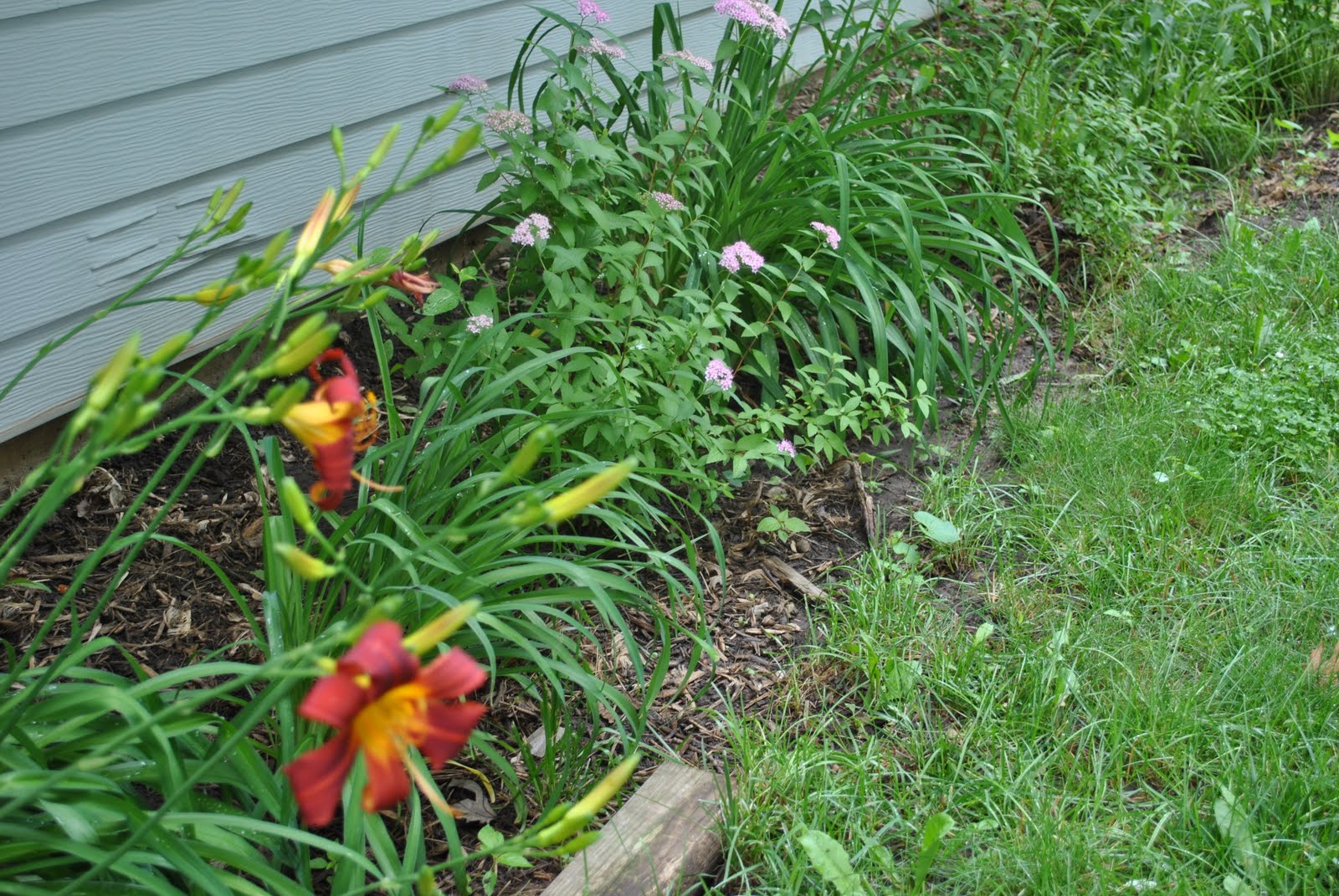
I have reconciled myself to the fact that I created a warm-color-scheme mess in this whole border, but that's just the way it's going to be. I have burgundy daylilies and these red and yellow ones

mixed with ice pink spireas (not pictured, as they are done blooming).

And in the rain garden, swamp milkweeds (Asclepias incarnata) and obedient plants (Physostegia virginiana) mix their pink blooms with the fiery red of the cardinal flowers.


It wasn't the most well thought out color scheme, but hey, all those hues are near each other on the color wheel, right? That's what I'll keep telling myself. The daylilies may get moved one day, but the rain garden plants have to stay where they are and they certainly are great for this purpose. They're absorbing our sudden and infrequent downpours and thriving beautifully, plus there have been monarchs galore around the milkweeds; I'm not about to lose all this ecological value over some shallow stylistic considerations. Once I realized that, I got very lazy about my plans to move the spireas, so pink and red this border may remain!

Of course now that I have the garden weeded and a second round of lettuce seeds just planted, I'll be leaving again for a 10-day jaunt late next week. What do you do when you're away from the garden? Is it acceptable to ask someone to water for you? And what's up with those squashes??

Monday, June 28, 2010

Coneflowers Hate Me

Coneflowers...ubiquitous, beloved, and resilient. I recommend them to others, I've written about them, and the variety of Echinaceas out there keeps multiplying every year. And yet they hate me.


This is the only coneflower I have had this year. It's a pale purple coneflower (Echinacea pallida), a cousin of E. purpurea that's native to the clay-busting shortgrass prairies of my region. Now granted, this plant is only two years old and pale purple coneflowers are by nature much less showy than their famous counterpart, but still...this is it??

Much more frustrating is this E. purpurea cultivar that has underperformed for so many years now that I can't even remember which one it is! (I think one of the Meadowbrights.)

I planted it in too much shade about three or four years ago (my fault), so I moved it the following spring to this sunny site where it's done nothing since. We're well beyond the "it's rejuvenating from the move" phase. What gives??


Then last fall I ordered some plain 'ole E. purpureas for my north border. Only three of the five or six are growing. In their defense, this could be my fault: did I mistake their shoots for weeds earlier this spring and pull them? Possible. Are they unable to grow in the horrible mix of clay and lava rocks? Certainly possible. But, excepting all that, these ones are still barely close to flowering despite plenty of moisture and (what I thought was) decent sun conditions.

I've been gardening for over 20 years, I'm a published garden writer, and yet some of the simplest, most common perennials defy my every attempt to grow them, be they rare native, normal type or fancy cultivar. It is remarkable the ability of plants to remind one of one's humility.

Tuesday, June 15, 2010

Bloom Day: Rained Out

Well, not entirely, but close to it. Over the weekend I was mentally kicking myself for writing a long post looking all through the garden when Bloom Day, hosted by Carol at May Dreams Garden, was only a few days away (which I had kind of forgotten about).

(Phlox drummondi)

But now I'm glad I lived in the garden's moment, because near constant rain over the last few days has stripped away most flowers.

Here's a look at what the salvia and sand coreopsis (C. lanceolata) looked like pre-rain:


The dianthus is going strong, thanks to it being protected by the yews.


Even some columbine blooms are still hanging on, although most are on their way to becoming seed pods.


The 'Plumosa' salvia is in full bloom, but it's splaying all over the place (to again borrow a phrase from Carol). You wouldn't know that these are actually being held up by stakes right now!


In one of the back borders near the rain garden my most horrid color clash is underway: pink spireas and bright red daylilies.


I was a little short-sighted about planting those spireas, and I do plan to get around to moving them. Individually the blooms are pretty...

...icy pink...


...and deep red...

...just not right next to each other.

Despite the rain damage there should be much more in store. Currently things in bud include big-leaved aster (Eurybia macrophylla), sweet joe-pye weed (Eupatorium maculatum), swamp milkweed (Asclepias incarnata), rattlesnake master (Eryngium yuccifolium), and the new roses. One started to bloom the tiniest, hesitant flower, a bit of a preview.

Monday, June 14, 2010

What is eating my squashes??


Dear Garden Blogosphere,
Can you identify what bug is causing this damage? (I'm assuming it's a bug because the leaves are chewed on but there's no stem damage a la birds or rabbits, the latter of which would have to climb over my 1' fencing to get into this bed.)

I have seen earwigs in the soil lately, thanks to numerous recent downpours. Other thoughts? The dreaded squash vine borer?


Most importantly, what can I do about it? Suggestions not including the use of poisonous chemicals would be most appreciated.


Hope to hear from you soon!

Wednesday, June 9, 2010

The most wonderful time...

I'll just say it--I love this time of year in the garden. Despite a spate of rainy, stormy weather that bordered on downright chilly, the garden is bursting with colors and textures and veggies of all sorts.


These nectaroscordums (N. siculum spp. bulgaricum) are even taller and more exotic looking than I expected, and they also reek unbelievably strongly of onions (they are members of the Allium family so I shouldn't be so shocked).


These seem to be one of those plants that look kind of so-so from far away, but close up you can really appreciate all their attributes. They're thriving in the clay mixed with remaining lava rocks, and for that alone they should be praised. I'm planning to add more bulbs this fall. If you have deer issues, I bet these reeking-of-onion plants would deter them. Just a thought.

In fact, it's turning out to be the Year of the Onion here. Look at how big the onions are in the veggie bed are:

There are red, white and yellow onions with some green ones to the left. For size comparison, here's a full view of the bed. Notice how the onion stalks (or whatever the green parts would technically be called) are as tall as the broccoli plants in the back.


Other vegetable delights include the pot 'o hot peppers, where all three (jalapeno, Thai chili and habanero) are growing quickly and starting to put out flowers. As someone who enjoys food so hot that it makes steam come out my ears, this is a joy in the making!


In the front garden, my cosmos and Phlox drummondi seedlings are finally starting to flower, and I'd like to thank everyone who suggested direct sowing cosmos...I will act on this advice next year!

In more positive seedling news, I have little cilantros popping up all over the herb section of the garden (they'll go great in those spicy Mexican and Thai dishes with the peppers!). I direct sowed a packet of Slow Bolt Cilantro from Renee's Garden and at first I feared most hadn't germinated, but in the past week or so they've shown up in droves. I know it's kind of hard to see, but there's one in this picture in front of the dianthus and columbine foliage. They seem to not be getting attacked by bugs like my basil seedlings (a big disappointment).

(Random side tangent, speaking of disappointments: My hyacinth bean seedlings have gone nowhere, despite me having little wire supports all ready for them at the base of the floor-to-roof posts we have along our front patio. They sort of look like they got eaten by a squirrel or something, or maybe they're suffering from too little sun, too little water, too much water--we've had both dry and soggy spells lately--but there's nothing happening. I think vines twining up the poles would look so great, but I can't seem to make it work! Why?! But I digress.)


Anyway, I planted some new Phlox pilosa in the front (and they are perfectly pink, as Gail would say). I'm thrilled with how brightly they're blooming after just a few short weeks in the garden! There is a fourth one that should be in the picture above, but while I was weeding the stem got snapped off, and I realized it was brown and a little brittle (please tell me it will grow back next year Gail?!).


These new hostas are my favorite things in the shady part of the front garden.

In the front left is 'Touch of Class' and to the back right is a nameless passalong from my mom; I like the way the light and dark parts of the leaves are reversed with the chartreuse in the center of 'Touch of Class' and on the margins of Nameless Passalong.


I accidentally became a rose gardener again. This one came with the house but has been languishing in weeds. I have no idea what it is but I tried to clear up the weeds around it when I planted a couple new quinces nearby.


I got these 'Candy Oh So Vivid Red' roses to trial from Proven Winners, which I hadn't known would be in the trial shipment.

Suddenly I realized that after an eleven year hiatus I now grow roses again. I'm thrilled that they're budding and I hope they're ready to grow without much pampering. We shall see!


I even managed to throw together some decent containers for the first time in a couple years. This one includes 'Double Blue Madness' petunias that are not blooming (unfortunately), with hemigraphis 'Blackberry Waffle' and some vinca vine. It will look much more exciting when the petunias bloom but I'm enjoying the contrast of the hemigraphis and vinca.


This container is in a sunnier spot, and it's got 'Red Plume' celosia with 'Diamond Frost' euphorbia and 'Ready to Wear Paris' calibrachoa. The hemigraphis and calibrachoa are from Hort Couture, and while I can't really say if they're particularly fashionable, they are growing vigorously and working well in these containers.

(Official disclaimer: the Proven Winners and Hort Couture plants were free trials...at this point I only like them for their merits as nice plants.)

The planting frenzy is over with all the veggie seeds and seedlings in, the containers done, and the annual seedlings and new perennials in the ground! Most surprisingly, I actually got off my butt and did a thorough weeding of the entire garden. Next is mulching, more weeding, hopefully successful harvesting, and soon enough bulb planting. How is your garden going, now that it's truly summer? What's next for it?

Wednesday, May 26, 2010

Wildflower Wednesday--Wild Hyacinth


Wild hyacinth (Camassia scilloides): native to North America with distribution from Ontario, Canada, down through the Midwest and Mid-Atlantic all the way to the Southeast and Texas. According to the USDA, it's endangered in Michigan, Wisconsin, North Carolina and Pennsylvania.

Here, it has been the star of the new south border. Its blooms are white shaded with the slightest hint of lavender.


As one of many new residents in this border, it's been the only one blooming this spring (which is not surprising).


It's been easy to grow and easy to love...takes part sun and average to dry soil, hardy in zones 4-8, reaching around 18" tall.

You May Also Like

Related Posts with Thumbnails