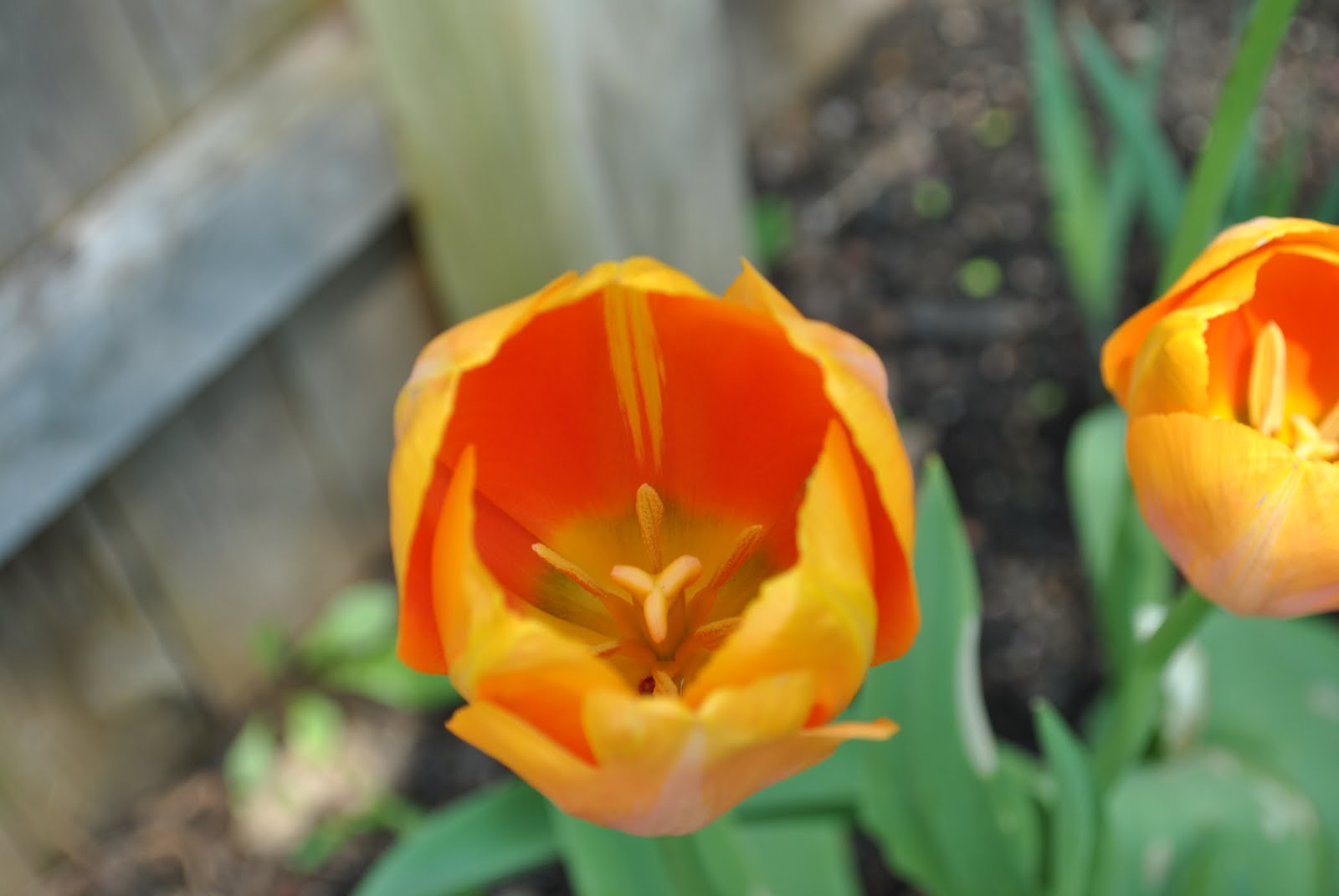
Every fall I say never again, and a year later I'm right back in the same place. Every spring I swear I won't put myself through the heartbreak, and seven months later I've convinced myself it will never happen again. I'm talking about spring bulbs, notably tulips, which I've fallen hopelessly and stupidly in love with over the last few years.
But planting bulbs six inches down in rocky clay is absolute hell. Or, more accurately, digging to plant those bulbs is hell. And while the flowers thrive admirably in the terrible soil (part of why I keep putting myself through the misery), they are all too often cut down just as they're about to burst into bloom, thanks to the abundance of rabbits and other rodents around here.
And then there's the forced bulbs. Potted hyacinths are intoxicating, in both form and fragrance. Beloved tulips, the finicky Triumph varieties that are drool-inducing in catalogs but really just high-effort annuals in the garden, are ideal for potting and forcing, which is by its nature a one-time deal, an excuse for palette-defying colors and experimentation that is only justifiable in the depths of winter.
But the fungus gnats! Every year they grow in intensity! I have no choice but to let the pots overwinter in the musty garage...there is no greenhouse, cold frame, basement, or cool closet where they could possibly go. And in that same vein of helplessness, I cannot banish the fungus gnats from the garage, even when I leave the potted bulbs almost completely dry throughout the winter, as I did last year.
So what is to be done? Well, in terms of the potted bulbs, it's to re-focus and go small. I potted only five 'Brown Sugar' and five 'Gavota' tulips and am taking a year off from hyacinths (having to throw them in the compost after the house became infested was so painful anyway that a break is good to heal that wound).
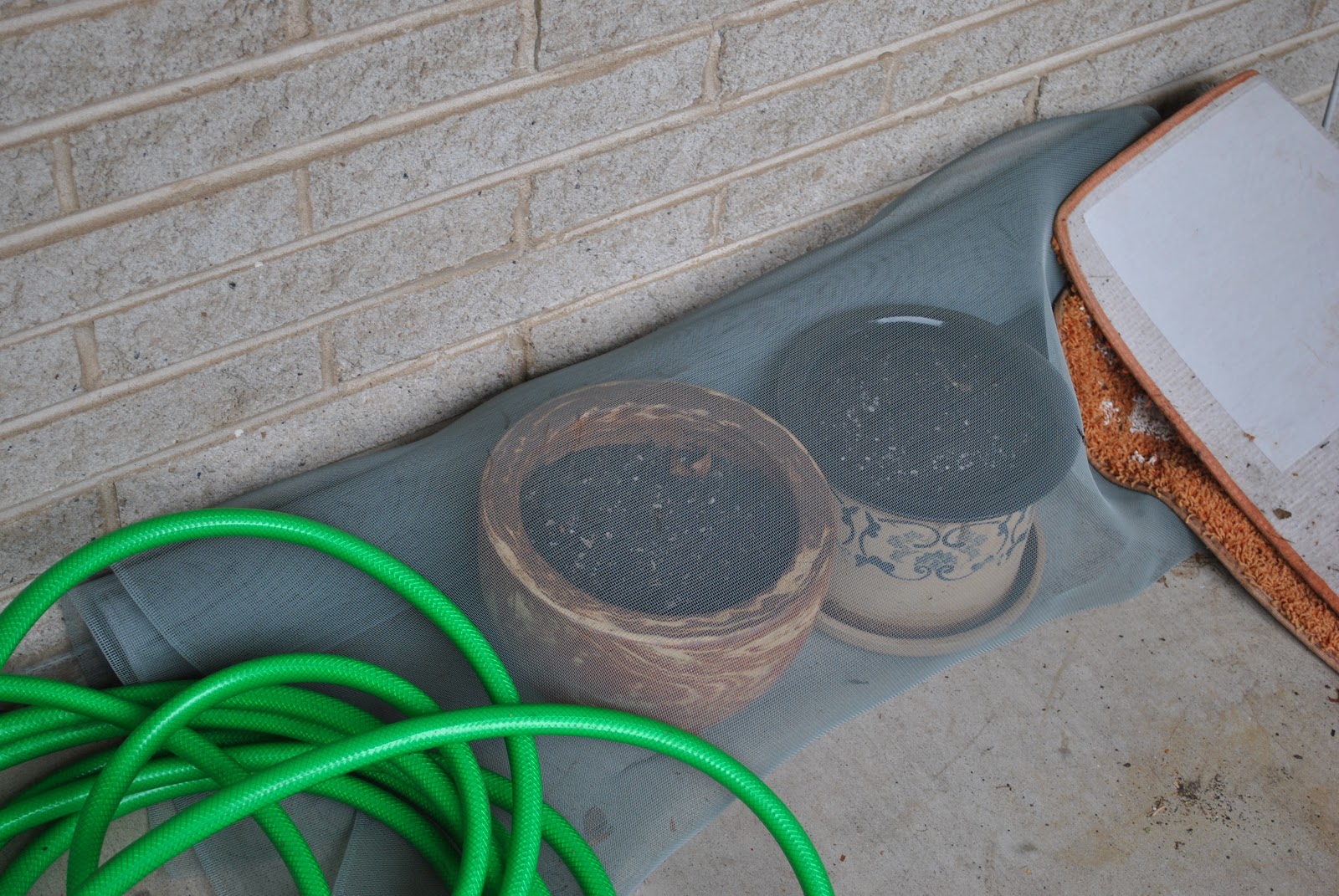
I developed the above contraption so that the pots can dry out on the patio, not in the garage where the fungus infestation would surely begin. And the wire mesh (held down unattractively but effectively by a hose and doormat) will hopefully keep out the rodent life until the soil dries up. At that point, the plan is to move the pots to the garage so they don't get destroyed by the cold temperatures, spray the top of the soil with chamomile tea (recommended by many gardeners for keeping fungus gnats at bay), and then displaying these pots outdoors in April, so even if they are infested with the damn gnats, the chilly spring air can take care of it.
As for toiling in the clay, I did it again but on a smaller scale than the last three years. I planted only 10 more 'Dordogne' and 10 'Cum Laude'. The former are so beautiful that I couldn't resist adding more, and the latter are a seductive purple that will offset the yellow-pinkish-ness of the 'Dordognes' at the end of the tulip season. It was hard work, but I've accepted the risks involved and plan to arm myself with hideous-smelling Liquid Fence again and hope for the best. I guess it's that "try again next year" attitude that is inherent to gardeners!
Showing posts with label tulips. Show all posts
Saturday, October 13, 2012
Sunday, May 15, 2011
May Bloom Day: Slow-Motion Spring
After a beautiful week of summer temperatures we're back to chilly, cloudy, early spring weather. A lot of plants have been in slow motion thanks to the delayed onset of spring, but nevertheless here's what's blooming...

...bleeding heart with a bumblebee and the first tentative blooms of yellow pimpernel (Taenidia integerrima)...

...I had to search under the foliage to find the flowers of these wild ginger (Asarum canadense). Definitely worth it! They're unique little blooms with red reflexed petals. These flowers lay on the ground sheltered under the large leaves.

Woodland phlox (P. divaricata) is blooming for the first time! I had kind of failed to get this groundcover happily established and spreading, but since the clumps are blooming that means they get to stay at least another year. Maybe it's a sign of good things to come from these plants!

Also making a strong performance is the prairie smoke (Geum triflorum). These buds are not fully in bloom yet but they're still so cool to see bobbing above the foliage. I can't wait for them to make it to the seed-head stage, which creates the real "smoke" looking part of their name.

All of my zizias (Z. aurea) are now in bloom. These water-loving plants have been very happy with all the rain this spring.

And what would May be without tulips? After a rocky start, my border of tulips has been lovely with a mix of yellow, purple and orange. I'm growing (foreground to back) 'Dordogne', 'Negrita', 'Rembrandt's Favorite', one 'El Cid' which returned from last year, and an un-named yellow variety.
The 'Dordognes' are a little more orange than I would have liked, but when you look close you can see gorgeous brush strokes of pink and apricot:

Even the inside of these tulips is artistic:

To enjoy more flowers visit Carol at May Dreams Garden, who hosts Garden Blogger's Bloom Day every month.
Also blooming but not pictured: hellebores, variegated Solomon's seal, violets, un-named tulips.
...bleeding heart with a bumblebee and the first tentative blooms of yellow pimpernel (Taenidia integerrima)...
...I had to search under the foliage to find the flowers of these wild ginger (Asarum canadense). Definitely worth it! They're unique little blooms with red reflexed petals. These flowers lay on the ground sheltered under the large leaves.
Woodland phlox (P. divaricata) is blooming for the first time! I had kind of failed to get this groundcover happily established and spreading, but since the clumps are blooming that means they get to stay at least another year. Maybe it's a sign of good things to come from these plants!
Also making a strong performance is the prairie smoke (Geum triflorum). These buds are not fully in bloom yet but they're still so cool to see bobbing above the foliage. I can't wait for them to make it to the seed-head stage, which creates the real "smoke" looking part of their name.
All of my zizias (Z. aurea) are now in bloom. These water-loving plants have been very happy with all the rain this spring.
And what would May be without tulips? After a rocky start, my border of tulips has been lovely with a mix of yellow, purple and orange. I'm growing (foreground to back) 'Dordogne', 'Negrita', 'Rembrandt's Favorite', one 'El Cid' which returned from last year, and an un-named yellow variety.
The 'Dordognes' are a little more orange than I would have liked, but when you look close you can see gorgeous brush strokes of pink and apricot:
Even the inside of these tulips is artistic:
To enjoy more flowers visit Carol at May Dreams Garden, who hosts Garden Blogger's Bloom Day every month.
Also blooming but not pictured: hellebores, variegated Solomon's seal, violets, un-named tulips.
Friday, May 13, 2011
How Not to Plant Tulips
Like this...in a long line rather than in a concentrated clump.
These tulips came with the house, so I am not actually responsible for this (although admittedly I haven't done anything about it for five years, so maybe I'm an accessory to plant design-acide).
But no longer! This is the year I dig these up and move them to the bed where I have massed tulips (and plan to mass more Darwin varieties so I don't have to do this every fall). But how should I move them? Or more specifically, when?
I would prefer to dig them up now once they've finished flowering because I know where they are. If I wait until the fall their foliage will be long gone and I'll be digging blindly.
Of course I could mark them with plant markers, but then I'll have marker sticks randomly around my garden all year. And they could get ruined by fall anyway. If the severe storms we had earlier this week happen with any sort of frequency I wouldn't be at all surprised to have plant markers washed away.
Has anyone out there successfully moved tulips post-flowering? Will I kill the bulbs if I do that? Feel free to leave suggestions!
Pictured at left, front to back: 'Dordogne', 'Negrita', 'Rembrandt's Favorite', one 'El Cid' and an un-named yellow variety.
Sunday, May 8, 2011
Tulip Trials
My Mother's Day present from the gardening gods was tulips...

...which all seemed to bloom almost simultaneously this weekend. It's not a moment too soon because I've been craving these flowers all spring and yet they've been plagued with issues!
Squirrels (or some other rodent culprit) have been decapitating my tulips just as they're on the verge of blooming! Look below the blurry-too-close-up yellow blooms in this picture and you'll see the evidence:

Stems bereft of their flower heads, which are being severed in the night just as the buds are about to open.
I am confident it's not deer because they're not around in my neighborhood (and if errant ones were to wander through it would be big news and immediately known.) In the previous five years I've grown tulips here I've never seen any damage like this and it's downright heartbreaking! But I have hope that my Tabasco topdressing will keep the killers away from the 'Dordognes', which will be blooming later than these varieties:

This is 'Rembrandt's Favorite' with solid purple 'Negrita'. I was so excited about this combo, and mixing it with the stately yellow perennial tulips in this bed (they must be Darwins).

Unfortunately the 'Negritas' are suffering some discolorations, which is rather taking away from the effect. I'm not sure if this is environmental (i.e., frost damage or poor soil), or if I should be aggravated with John Scheepers and stick to bulb-buying with Brent & Becky's.

One 'El Cid' from last year returned, and perfectly placed between the pure yellows and the bi-color Rembrandts.

I struggled mightily to dig trenches in this border with its terrible soil and remnant lava rocks, and last October I swore I would never plant tulips here again. But they would look so out of place in my other borders, and I have to say I've been really enjoying playing with color combos the last couple years. I know they're like annuals that take tons of extra labor...

...and they don't really flow well with look and feel of the rest of my garden...

...but I really loved those 'Ad Rems' I saw at the Chicago Flower & Garden Show and thought maybe next year...
...which all seemed to bloom almost simultaneously this weekend. It's not a moment too soon because I've been craving these flowers all spring and yet they've been plagued with issues!
Squirrels (or some other rodent culprit) have been decapitating my tulips just as they're on the verge of blooming! Look below the blurry-too-close-up yellow blooms in this picture and you'll see the evidence:
Stems bereft of their flower heads, which are being severed in the night just as the buds are about to open.
I am confident it's not deer because they're not around in my neighborhood (and if errant ones were to wander through it would be big news and immediately known.) In the previous five years I've grown tulips here I've never seen any damage like this and it's downright heartbreaking! But I have hope that my Tabasco topdressing will keep the killers away from the 'Dordognes', which will be blooming later than these varieties:
This is 'Rembrandt's Favorite' with solid purple 'Negrita'. I was so excited about this combo, and mixing it with the stately yellow perennial tulips in this bed (they must be Darwins).
Unfortunately the 'Negritas' are suffering some discolorations, which is rather taking away from the effect. I'm not sure if this is environmental (i.e., frost damage or poor soil), or if I should be aggravated with John Scheepers and stick to bulb-buying with Brent & Becky's.
One 'El Cid' from last year returned, and perfectly placed between the pure yellows and the bi-color Rembrandts.
I struggled mightily to dig trenches in this border with its terrible soil and remnant lava rocks, and last October I swore I would never plant tulips here again. But they would look so out of place in my other borders, and I have to say I've been really enjoying playing with color combos the last couple years. I know they're like annuals that take tons of extra labor...
...and they don't really flow well with look and feel of the rest of my garden...
...but I really loved those 'Ad Rems' I saw at the Chicago Flower & Garden Show and thought maybe next year...
Wednesday, April 28, 2010
Tulipomania!
It's Tulipomania around here! We've got pink ones...

...species ones (T. linifolia, I believe; like most of the tulips, they came with the house)...

...some more purple and yellow ones not pictured here and of course...

...the 'El Cids'!
They waited for me to get home to put on their show, and overall they're delightful. You can see their frosted outer stripe, paintbrush strokes of magenta, and purple stems.

They're not as purple as I had been led to believe by the Brent & Becky's catalog, but it actually worked out OK because the yellow tulips nearby feature petals lined almost imperceptibly with red (click to enlarge if needed).

The color combo is quite nice, and the soft cream of the 'City of Haarlem' hyacinths isn't bad either. The only downside is that some of the flowers are a little deformed, as you can see to the right of this picture:

It's probably the shoddy soil quality or lack of sun. But despite the little imperfections this small spring bulb vignette has fanned my Tulipomania.
...species ones (T. linifolia, I believe; like most of the tulips, they came with the house)...
...some more purple and yellow ones not pictured here and of course...
...the 'El Cids'!
They waited for me to get home to put on their show, and overall they're delightful. You can see their frosted outer stripe, paintbrush strokes of magenta, and purple stems.
They're not as purple as I had been led to believe by the Brent & Becky's catalog, but it actually worked out OK because the yellow tulips nearby feature petals lined almost imperceptibly with red (click to enlarge if needed).
The color combo is quite nice, and the soft cream of the 'City of Haarlem' hyacinths isn't bad either. The only downside is that some of the flowers are a little deformed, as you can see to the right of this picture:
It's probably the shoddy soil quality or lack of sun. But despite the little imperfections this small spring bulb vignette has fanned my Tulipomania.
Thursday, March 18, 2010
On the Verge
Some may say this is a late spring, but compared to last year I think it's fabulous. At this time last year I barely had a few irises and tulips peeking out of the ground, but this year the daffodils are already in bud!
Peonies are showing their hot pink shoots, and my great blue lobelia (L. siphilitica) has formed its mat of early green growth.
A number of columbines are gracefully unfurling themselves...
...including this tiny little guy! (Sorry it's so blurry.) This is one of last year's seedlings that has so far survived.
Here is one of my favorite examples of the resiliency of plants in the face of my stupidity:
I laugh out loud every year when I see this tulip bravely pushing through the oregano plant that I plunked on top of it three years ago, obviously in the summertime when the tulip had long been dormant and forgotten. This is a perfect reason to utilize plant tags!
I've noticed a number of natives in the back gardens also coming to life, including wild hyacinth (Camassia scilloides), nodding wild onion (Allium cernuum) and prairie smoke (Geum triflorum). My trout lilies, 'City of Haarlem' hyacinths and 'El Cid' tulips are, for the most part, conspicuous in their absence, and my 'Ruffled Velvet' Siberian irises are nowhere to be found! I am positively aggravated about that last one, but I'm hoping they're just late starters. Has anyone had experience with Siberian irises coming up later than bearded irises (which are robustly growing in the front garden, as seen in the top photo)?
Ominously, we're expecting a late winter snowstorm this weekend and I'm concerned about all the fresh young growth that could get killed. The columbine seedlings are a particular worry. But that's life in a Midwestern garden! I already have a number of seedlings to replace any that might not make it this spring, which is the best insurance policy!
Friday, March 20, 2009
Welcome Astronomical Spring
Spring is definitely the season when non-native plants dominate my garden. I have no problem with this, because at this point in the year I'm so happy to have anything growing outside in warm temperatures that I hardly care what its provenance might be. This situation will be changing, however, because I'm planting shooting stars (Dodecatheon meadia) and yellow pimpernels (Taenidia integerrima) this year, which will add a native woodland touch to my spring garden.
So despite the leaves still strewn across my garden, ostensibly for protection from the temperatures that are still hovering around freezing right now, I've got tulips (top), daffodils (middle), and irises(bottom) peeking out above the soil. These irises have spread prodigiously over the past two years. Even last spring there were not nearly this many, and this photo only shows one stand of them. There are many more beneath the leaves near these guys. I'm not sure what type of iris these are (Siberian, bearded, etc.) Perhaps when I have pictures of them in bloom, you can help me! I inherited the tulips and daffodils from the previous owner when I moved into the house, and they've bloomed better each year. Since I'm not sure where all the bulbs are, I have dug into a couple and ruined them, but every spring there's random tulips where there weren't any before, and they range from yellow to pink to red. Always a nice surprise!
At this point, I'm a little worried about frost damage. It was in the 20s last night and it doesn't show much sign of warming significantly in the next couple days. This is always a dangerous time for plants in the Chicago area. I tried covering the irises again with the leaves after I took that picture. Hopefully the weather will cooperate and I can throw the blanket off the whole thing in a few days. In the meantime, at least there's plant potential underneath!
PS-Those cyclamens from Garden Blooms Day seemed to have shriveled. I am fascinated by the sculptural beauty of cyclamens, but I have now killed them as houseplants and as bulbs in my garden. Why??! How does one raise cyclamens successfully?!
Labels:
cyclamens,
daffodils,
iris,
shooting star,
spring bulbs,
tulips,
yellow pimpernel
Subscribe to:
Posts (Atom)