Tuesday, September 14, 2010

Bloom Day, Finally!

For the first time since June I am in the garden for Bloom Day! And I'm quite happy about it because there are still a notable number of blooms to be seen. Maybe the cooler temperatures are prolonging some flowers that might have wilted in the continual heat.


The Bon Bon Cosmos from Renee's Garden are looking the best they have all season! Where have these robust blooms been? Maybe the site conditions aren't the greatest for these flowers, but this is a classic case of better late than never.


The 'David' phlox is still going strong although I can feel that the end may be near. It's been quite a show from these flowers this year. I'm a little irritated by the fact that they both have flopped all summer, but the flowers have been gorgeous even from their lowered level! And with the heat and dryness followed by intermittent torrential downpours, it's kind of hard to blame the stems for suffering a little. Considering the challenging conditions this year, we may have a candidate for Most Valuable Plant here.

The elm-leaved goldenrod (Solidago ulmifolia) is turning out even better than I had hoped!

I love how its flowers trail off the plant like a comet's tail, and the yellow perfectly complements the yellow centers of the big-leaved asters (Eurybia macrophylla) behind them.


And speaking of goldenrods, the zig-zag goldenrod (S. flexicaulis) is in its full glory...


...with the great blue lobelia finishing up...


...and speaking of asters, the smooth blue asters (Symphyotrichum laeve) have exploded within the past couple days!

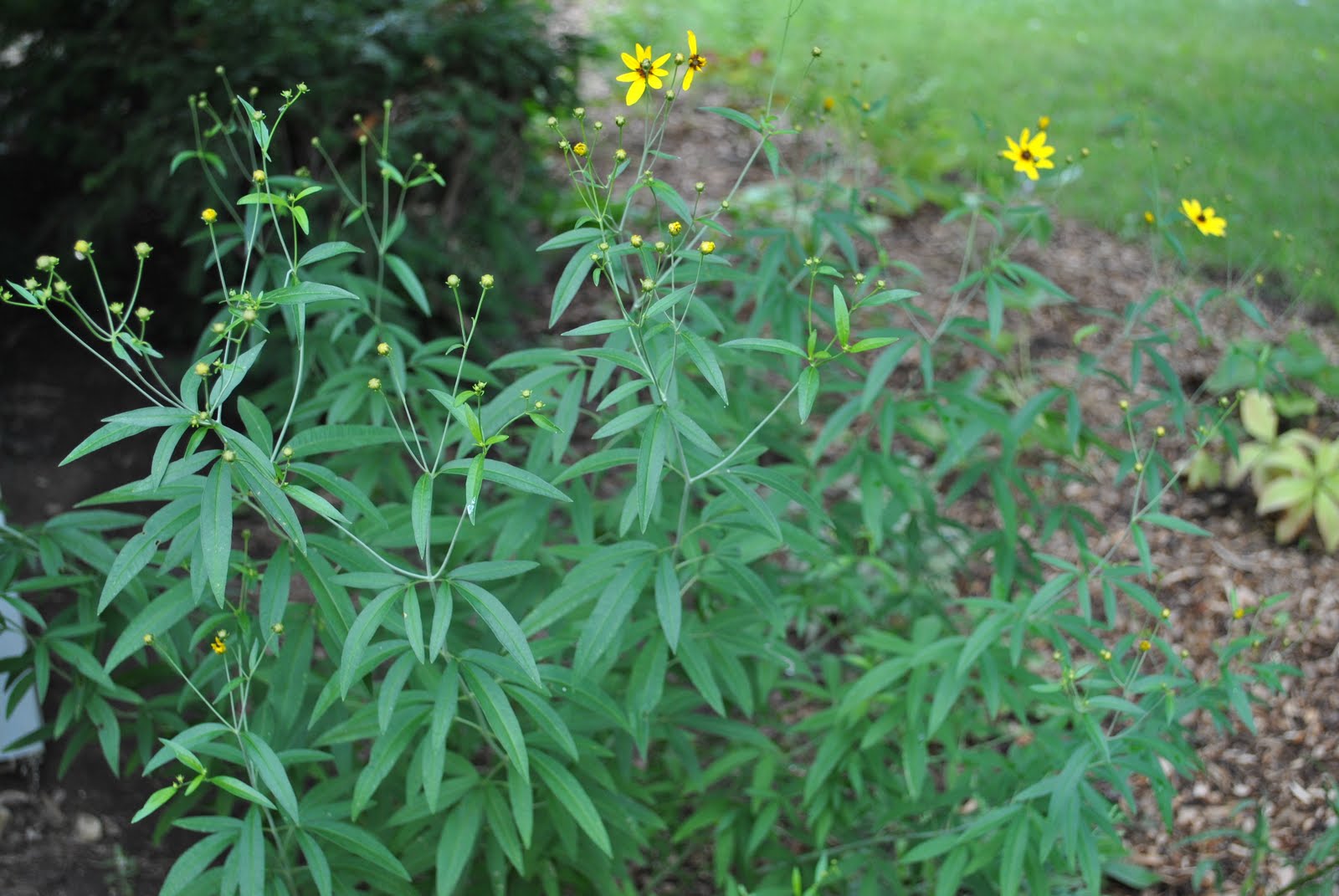
They're looking much better than last year, probably due to the sunny, dry conditions. And they've flowered early enough to catch the tall coreopsis (C. tripteris) still in bloom!

This timing doesn't happen every year and I love when it does! It's nice to have the yellow and blue combo repeated a couple times in this border.

My containers were suffering from my absence, so I replaced the wilted petunias, calibrachoa and celosia with simple pansies. Here's how the petunia replacement looks now:

What's notable is that the other fillers in these containers (second one not pictured) haven't missed a beat, and now they're looking as nice as ever!

Also blooming but not pictured: Tricyrtis 'Tojen'; squash flowers, the random unnamed rose and a couple fading coneflowers. For more Bloom Day posts, see Carol at May Dreams Garden!

Sunday, September 12, 2010

An Open Letter to Monarda


OK, Monarda fistulosa or wild bergamot, or whatever you like to call yourself, it's time for us to reach an understanding. You have one more year. That's right, one more year in which I promise to give you the attention and powdery mildew prevention you deserve, and in return you will give me blooms. Or else you're gone.


That goes for you too, new seedling from One Seed Chicago, which has grown so vigorously and unexpectedly well. Your effort has not gone unnoticed. Nor has the creeping whiteness on your leaves, which doesn't look quite like powdery mildew but might be something else, maybe even something more pernicious.


I'm just sick of it. I'm sick of the flopping, the engulfing mildew, and yet I admit that I myself am partly to blame. When I sprayed you regularly and repeatedly with a milk/water mixture, the progress of the mildew was stopped. But I didn't stay as vigilant as I should have, and for that I'm sorry. Many, many sojourns away from the garden this summer put you farther down the list of priorities, and once I knew that you would withhold your blooms again this year I lost my remaining motivation to keep up with the spraying.

So let's start fresh. Next spring, I will dutifully and regularly spray you with the milk mixture, and in return you will have flowers. Even little ones. It's only fair; it will officially be the "leap" year for your growth (of course not the actual leap year of having a February 29th, but your third year in the garden, having passed the "sleep" and "creep" years). What do you say? Wouldn't it be better to stay amongst the goldenrods and asters and even the irises nearby, as opposed to an ignominious end in the garbage? (Because of course you can't be composted with all that powdery mildew!)

So it's a deal. One more year, with mutual attention paid. In honor of this, my 100th post, it just seems fair.

Tuesday, August 24, 2010

Wildflower Wednesday--Late Bloomers

By late summer, when many plants are past their peak, numerous prairie natives reach their zenith. In my garden, wildflowers of the shortgrass prairie and wet prairie are still putting on a colorful show.

Lobelias are going strong, both the cardinal flower (L. cardinalis)


and great blue lobelia (L. siphilitica).

Recently I saw a hummingbird at the cardinal flower, which was the cause of great excitement! I didn't think anything as cool as a hummingbird would come anywhere near the Suburban Wasteland, but lo and behold there was one feasting in my rain garden! Of course there is no photographic evidence; I just stood in shock for about 20 seconds until it flew away. But that was good enough for me! Both of these lobelias prefer wet soil, including periodic flood conditions, and they tolerate partial shade. They're native to swampy prairies and savannas, such as those that flourished here in the northern Illinois clay prior to settlement.

OK, moving on...

Goldenrods are starting to bloom, such as zig-zag goldenrod (Solidago flexicaulis)

and elm-leaved goldenrod (S. ulmifolia),


the latter which grows well in the shade with big-leaved aster (Eurybia macrophylla).


A lazily late-blooming liatris (L. aspera) is mixing its fuzzy purple blooms with tall coreopsis (C. tripteris)


which even by itself is as cheerful as a black-eyed susan or sunflower.


My Joe-Pye weed (Eupatorium maculatum) is well on its way to becoming frilly masses of tannish seeds, but it's still covered in pollinators (enlarge to see the bumblebee)

and other visitors.


The shortgrass prairie still has weeks to go before it settles down for late fall and winter, with grasses and the Plants Formerly Known as Asters still gearing up for their final flowering.

For more wildflowers blooming this Wednesday, see Gail and Clay and Limestone!

Monday, August 23, 2010

What I learned on my summer vacation...

It's hard to believe that summer is nearly over, and the consistently warm and sunny weather belies what the calendar is telling me. The growing season still has another good seven weeks or so before we can expect a true frost, but as we turn into the home stretch I'm inclined to look back on this whirlwind summer and what lessons it's imparted.


1. It's the mulch, stupid!
This is rather embarrassing to admit, but I didn't mulch the vegetable bed this year and that was a major oversight! As someone who uses mulch quasi-religiously on the ornamental beds, and who has recommended the use of said mulch in multiple magazine articles, I really dropped the ball here! The lack of mulch contributed to tomato cracking and blossom end rot on some bell peppers, since the moisture level fluctuated rather wildly thanks to my frequent trips out of town and our periodic drought conditions. I guess I fooled myself into thinking mulch would be unnecessary and/or cumbersome because the bed is so small. However, I got a great suggestion from Garden Girl in a comment on a previous post about using leaf mold as a mulch, and I intend to give it a try next year.

2. Grow more hot peppers.

I have been scalding myself on a regular basis, and judging by the looks of these chili peppers it's set to continue. The habaneros are coming along beautifully too. I can't guarantee that next year will have the hot, sunny weather that this year has had, which is perfect for these peppers, but it's certainly worth another try!

3. Abject neglect will kill a container garden.
Before my week-and-a-half excursion away from home:


After:

The 'Diamond Frost' euphorbia is making a valiant effort to keep this container going, but the 'Ready to Wear' calibrachoa from Hort Couture and the 'Red Plume' celosia just couldn't handle the abuse.

4. Abject neglect will not necessarily kill a container garden.

This pot is in the shade, which undoubtedly helped its survival while I was gone. It's simple but I've been enjoying this container all season. Look at the nice crinkly texture of the 'Blackberry Waffle' hemigraphis, also from Hort Couture.


5. Abject neglect will kill a tree.
No photos of this involuntary arboricide. Let's just leave it at this: I bought a darling dwarf Canadian hemlock 'Pendula' that I was nursing along in a container with the intention of planting it in my problematic north border this fall. But I let it get too dry (I think), then I tried to overcompensate with too much water (I think), but I couldn't stop the downward spiral. I'm still not quite sure exactly how it happened, but I have officially killed a tree. Dark days.

6. Squashes need tons of sun.

I have gotten a whopping three cucumbers this year, and my four varieties of squash have produced exactly zero. The lush foliar growth and abundant flowers tells me there is hope for squashes here, but more sun would probably be a good idea. I expect to move the trellis next year, plant solely vining varieties to maximize sunlight exposure, and just generally lay out the veggie bed better next year.

7. Phlox paniculata and purple hyssop make a great combo.

OK, so I don't actually have many pictures of this combo because I mostly observed it in the frenzied weeks of late as I ran from the front door to the car, and later jumped from the car and ran back to the house, thinking as I streamed past the front garden, "Wow, those really look nice. Maybe I should take a picture. Maybe I should get more of them..." and then a thousand other things happened before I actually got the camera. But trust me, these 'David' phloxes and the hyssop (Agastache foeniculum) have anchored the front border since late July, and I like the textural contrast between the spiky hyssops and rounded, delicate phloxes.


So what did you learn this summer? Was it a good summer vacation, or are you ready for fall?

FTC Disclaimer: I got the calibrachoa and hemigraphis complimentary from Hort Couture, but as you should be able to see from this post, I am not predisposed to solely praise them.

Tuesday, August 3, 2010

Here come habaneros...


...among other scalding selections in the container 'o fire. The bell and sweet peppers are putting out fruit, and my tomatoes have produced vigorously but...


...inconsistent moisture and my shoddy watering have resulted in lots of cracking problems! As a relatively inexperienced tomato grower, I reached out to two sources of garden wisdom: my local extension office and my mother. I found out that as long as no infestation gets into the cracks, the tomatoes are still edible (extension office), and if I pick the tomatoes and let them ripen in the relatively infestation-free house, there is a better chance they'll make it to maturity (mother).


The Cherokee Purple tomatoes are coming in first in the race to ripen, and I just hope enough of these, as well as the Amish Paste and Black Krim, can be salvaged. Of course, most of these will probably ripen this weekend while we are out of town. Luckily they will not go to waste because my mom (the same source of tomato wisdom) will be checking on and watering the garden in our absence, and in return she has exclusive rights to any ripe tomato!


The plants are still putting out more fruit, and I will try to be more diligent about maintaining consistent moisture in the raised bed. One lesson I've learned so far this year: vegetables take much more water than I anticipated!

But just as I was moping about the tomato cracks and sullenly harvesting the affected fruits, I saw something that made me ecstatic to be growing vegetables and which inspired that jolt of satisfaction only gardening can provide...

...I have cucumbers!! All year I've wrangled with my squash-less squashes and cucumber-less cucumbers. But I think I've isolated the issue: not enough sun in the back of the bed. The fact that this cucumber (and its lone companion) are in a very sunny site, far from the trellis where they're meant to be, sort of confirms my suspicions.


In other happenings, 'David' phloxes and purple hyssop (Agastache foeniculum) have made a dynamic duo this summer, and I am planning to add more of both next spring.


The Joe-Pye weed (Eupatorium maculatum) is flopping because of the recent rains, but some visitors don't seem to mind.


In the shady part of the front garden, big-leaved aster (Eurybia macrophylla) is in full bloom and playing nice with new elm-leaved goldenrod (Solidago ulmifolia) that just might bloom this year, and the coleus.


And my new 'Touch of Class' hosta is sending up tentative flower scapes...I'm so happy it's happy enough to be flowering! I look forward to this beauty getting even bigger and better.


The tall coreopsis (C. tripteris) is late blooming this year; I hope it can save some flowers for when I'm back!


I only planted two containers this year, and I'm happy with my decision to go for quality not quantity. This mixture 'Diamond Frost' euphorbia, 'Red Plume' celosia and 'Ready to Wear Paris' calibrachoa (which was a complementary trial from Hort Couture) has held up beautifully through heat, dryness and humidity (albeit with regular watering).

Yet again I will be missing Bloom Day on August 15th, but I look forward to seeing what everyone else has in their gardens! I guess this is my pseudo-Bloom Day post!

Wednesday, July 28, 2010

Wildflower Wednesday--Nodding Wild Onion


Nodding wild onion (Allium cernuum) is a dainty member of the onion family that blooms with icy pink-nearly white clusters of dangling flowers.


These plants were passalongs from Mr. McGregor's Daughter, and they are thriving in part sun. They're mixed with a number of other prairie natives, including rattlesnake master (Eryngium yuccifolium), yellow coneflower (Ratbida pinnata), Short's aster (A. shortii), wild hyacinth (Camassia scilloides) and 'Twilite' baptisias. As this is a new border, most of those have finished blooming or are gearing up for next year.

For more wildflowers this Wednesday, see Gail at Clay and Limestone!

Monday, July 26, 2010

Long Time, No Blog

Well, I have been out of the loop lately! I missed Buffa10 and July Bloom Day, although I have enjoyed everyone else's posts on those topics. My reasons for this are work and life, but nevertheless the garden is carrying along quite well in our hot, sunny summer weather!

The Joe-Pye Weed (Eupatorium maculatum) is in full flower, and I'm happy to report others are enjoying it besides me.


The vegetable garden is a bit of a mixed bag. The tomatoes are growing splendidly at this point, no doubt encouraged by the weather.


I have only three--Amish Paste, Cherokee Purple and Black Krim--but all are bearing lots of as-yet-unripened fruit.


Cherokee Purple is winning the race for first tomato to ripen.

All the peppers are similarly thriving, such as these Thai chili peppers in the container 'o fire (which also includes a jalepeno and habanero).


But what's wrong with my squashes (and cucumbers) again?! All I have are these:


Lots of pretty flowers, but no squash (or zucchini or cucumbers). This cucumber vine is threatening to take over the whole bed, and I had to cut its tendrils off the tomatoes, yet no veggies!!


I have borage planted nearby to draw pollinators, and there's more near the tomatoes (which have obviously been pollinated). There are bees, wasps and flying bugs of all kinds around this garden constantly, so what's going on?

Right next door, the rain garden is coming into its own this year. The cardinal flowers (Lobelia cardinalis) are blooming brightly.


I have reconciled myself to the fact that I created a warm-color-scheme mess in this whole border, but that's just the way it's going to be. I have burgundy daylilies and these red and yellow ones

mixed with ice pink spireas (not pictured, as they are done blooming).

And in the rain garden, swamp milkweeds (Asclepias incarnata) and obedient plants (Physostegia virginiana) mix their pink blooms with the fiery red of the cardinal flowers.


It wasn't the most well thought out color scheme, but hey, all those hues are near each other on the color wheel, right? That's what I'll keep telling myself. The daylilies may get moved one day, but the rain garden plants have to stay where they are and they certainly are great for this purpose. They're absorbing our sudden and infrequent downpours and thriving beautifully, plus there have been monarchs galore around the milkweeds; I'm not about to lose all this ecological value over some shallow stylistic considerations. Once I realized that, I got very lazy about my plans to move the spireas, so pink and red this border may remain!

Of course now that I have the garden weeded and a second round of lettuce seeds just planted, I'll be leaving again for a 10-day jaunt late next week. What do you do when you're away from the garden? Is it acceptable to ask someone to water for you? And what's up with those squashes??

You May Also Like

Related Posts with Thumbnails