Wednesday, June 15, 2011

June Bloom Day--Full Stride

A hectic week means a late post for Bloom Day, which is hosted each month by Carol of May Dreams Garden. But this is quite possibly my favorite month, and I'm happy to share some of what's blooming here. So without further ado...


Prairie phlox (P. pilosa), or as Gail from Clay and Limestone refers to them, Practically Perfect Pink Phlox.


Unknown pollinator on a sand coreopsis (C. lanceolata).


Peonies before rain damage...they're still OK now but looking a little worse for the wear after some intense rainstorms recently.


'Moonshine' yarrows are day-glow yellow.


Sand coreopsis, salvia and a peony.

Also blooming but not pictured:
Yellow pimpernel (Taenidia integgerima)
Coral bells
Alumroot (Heuchura richardsonii)
Harebell (Campanula rotundifolia)
Nectaroscordums (N. siculum)

Friday, June 10, 2011

Rain Gardens 104: Maintenance

You have a functioning rain garden! You've chosen the site, dug the garden and planted it with region-appropriate, flood/drought-tolerant natives! Now what?


Well, there is a small amount of maintenance involved. As with any garden, in the first year when the plants are new you will probably have to water. No, the irony of watering a rain garden is not lost on me. But unless you get regular rains at least once a week or so for the entire spring, summer and fall, you will probably need to water at least a little bit to make sure the plants are established. Like any other garden, observe your plants to know when watering is needed. Are their leaves drooping? Do they look dried out? If so, it's time to water.

Once the garden is established, you can expect the normal type of maintenance you would with most perennials: weeding and dividing. I do my best to mulch my rain garden because it helps cut down on weeds, but with so much moisture in the soil you can bet that weeds will grow. Be prepared.

Also, if your rain garden plants are really happy they can end up looking like this:

out of control! They can get floppy, rambly, and generally unkempt looking if you let them (this is a reality of many native plants...they often do not have the prim habits of their more cultivated cousins).

If this happens you should be pleased that your plants are doing so well, and then you should do whatever you need to make your rain garden more aesthetically pleasing. That can mean dividing sedges, zizias, etc. until they're in smaller and more manageable clumps; it can mean removing overzealous plants like Physostegia; it can mean cutting back things that are getting out of hand. This year a couple really hard downpours knocked over a bunch of my zizias, so I just cut off the broken stems and flowers. The foliage still looks nice and there is no reason for undue messiness. The roots are still absorbing plenty of rain water.

However, you shouldn't be shocked or uncomfortable with a "naturalistic" look if you're growing a rain garden with native plants. It's going to happen. So keep it looking "pretty" naturalistic. For example, I like this:


Lastly, be aware that mulch floats. As I mentioned before, mulch helps cut down on weeds and I think it just makes gardens (rain or otherwise) look nicer. But yes it will float around when the garden is full of water, and after large rains you will need to clear it off plants and redistribute it. This really isn't difficult or time-consuming, just something to be aware of.

And that's it! Now you know how to create a beautiful, ecologically friendly rain garden! Please don't hesitate to leave further questions in the comments, and see the previous posts for more info:

Rain Gardens 101: How to Choose a Site
Rain Gardens 102: How to Dig the Garden
Rain Gardens 103: The Plants

Tuesday, June 7, 2011

Designing with Natives: Spring Bloomers


This is a simple yet serendipitous pairing: Camassia (C. scilloides) with prairie smoke (Geum triflorum).

The camassia (in the background) has the classic "bare ankles" problem: its flowers are on stalks above a little clump of wimpy basal foliage that just lays there. But put prairie smoke around it and the ferny leaves and interesting flowers/seed heads will perfectly cover the blank spots!


You can see the prairie smoke a little better here. These plants only get to about 10-12" tall, so it's like the camassia is just a head taller than the prairie smoke.


I wish I had planted these closer together, and hopefully the prairie smoke will need dividing in a year or so and then I can surround some of the camassias farther back with more of them. I also like the mix of the icy blue and rich pink flowers. These photos are from a couple weeks ago and now the Geum is moving into the "smoke" phase. But what a nice coincidence this pairing has been in my south border! If you're in the temperate zones 4-ish to 8-ish, give this duo a try!

Wednesday, June 1, 2011

Rain Gardens 103: The Plants

I sincerely apologize for how long it's taken me to make this post!! I intended to complete my little "how to create a rain garden" series in a couple of weeks, and it took me well over a month! Ah well, the important part is that we're continuing now...

So you've selected a rain garden site and done the actual digging of the garden...now it's time for the fun part: the plants!

As in all gardens, rain or otherwise, the adage "right plant, right site" should be observed. All your plants will have to be able to tolerate repeated flooding as well as periods of dryness, unless your rain garden site is really swampy. For this reason it is generally recommended that rain gardens use native plants (meaning those native to your region).

Face it--at some point you'll probably be experiencing some degree of drought, and deep-rooted natives are usually better equipped to handle dry conditions as well as soak up intense amounts of water. On top of these qualities, native North American plants also host numerous pollinators and other forms of wildlife, including butterflies and birds.

So without further ado, here are recommendations for rain garden plants for sunny sites and shadier sites, all of which are hardy in approximately zones 4 to 8. I grow a number of these in my rain garden, and others I have researched as part of various article assignments. I've included flowers and sedges and one grass species. Sedges are really better suited to rain garden conditions and they sort of take the stylistic place of ornamental grasses in these settings.

Rain Garden Plants for Sun


Golden Alexander (Zizia aurea): Great plant! Host for swallowtail butterflies, will get very robust with lots of water and full sun.

Swamp Milkweed (Asclepias incarnata): Lovely pink color, really needs full sun. As a milkweed it's also a monarch host plant.

New England Aster (Symphyotrichum novae-angliae): Can be floppy, consider using on the berm.

Blue Flag Iris (I. virginica): Beautiful classic purple iris flowers. Needs full sun; mine are being dwarfed by larger plants and struggling. I suggest planting them when you first start the garden to avoid this situation.

Sneezeweed (Helenium autumnale): Good late-season yellow color after most plants are done flowering. Does not actually cause sneezing.


Obedient Plant (Physostegia virginiana): Beautiful, distinctively shaped pink flowers. Inaccurately named; not obedient at all. Will spread prodigiously in moist conditions; this is good if you need to fill space, otherwise be prepared to fight back.

Culver's Root (Veronicastrum virginicum): Reaches 5-7 tall with spikes of white flowers; grow it in the center of the rain garden so other surrounding plants will complement it.

Porcupine Sedge (Carex hystericina): Very robust in full sun.

Muskingum Sedge (C. muskingumensis): Can reach up to 3' tall; also takes partial shade.


Fox Sedge (C. stipata): Very interesting, spiky-looking inflorescences.

Prairie Dropseed (Sporobolus heterolepis): Beautiful soft texture, consider growing on the berm or a spot that is not the wettest in the rain garden.

Rain Garden Plants for Shade


Cardinal Flower (Lobelia cardinalis): Great red color and wonderful for hummingbirds. I have actually witnessed a hummingbird at mine here, in total suburban wasteland.

Great Blue Lobelia (L. siphilitica): Gorgeous blue, not as tall as cardinal flower.

Pink Turtlehead (Chelone obliqua): Unique purplish flower; rare plant.

Graceful Sedge (C. gracilima): Up to 2' tall, arching habit.

Bur Sedge (C. grayi): Distinctive inflorescences.


Pennsylvania Sedge (C. pensylvanica): Good for the berm, not the soggiest spot. Will spread slowly over time.

Astilbe (genus Astilbe): Please note: this is not a native plant, but a moisture-tolerant shade plant! I do not grow astilbes in my rain garden but they were once recommended to me as a potential choice by a reputable source in the midst of an interview. Since shade flowers are in short supply for these conditions, I figured it was worth mentioning, native or not.

I'm sorry I don't have pictures of all these plants, but for good photos and more information please see Illinois Wildflowers. They have a section on wetland wildflowers, as well as prairie ones (some of which are included in the list for sun here), and grasses and sedges. Although it is named "Illinois," the plants on this website are native to much of the Midwest and Eastern U.S.

So to Recap:
Remember, there are lots of other options out there, depending on where you garden! Always consult local sources for what is native to your area, and evaluate your particular site conditions for the appropriate plants. These are suggestions only!

Next up...rain garden maintenance!

Wednesday, May 25, 2011

Wildflower Wednesday: Wildflowers for Shade

There is more to shade gardening than hostas! In fact there are a number of North American native flowers for shady areas. On this Wildflower Wednesday, hosted by Gail at Clay and Limestone, I would like to share some shade wildflower successes from my zone 5 garden.


This is woodland phlox (P. divaricata). These have been blooming their heads off for a couple weeks now and they absolutely light up this shady border. They haven't spread to groundcover status as much as I would have hoped, but the flowers are so pretty I'm thinking of planting more to help connect the blobs I currently have. If you have shade that is at least sort of reliably moist, you should not miss out on these lovelies!

Heucheras are like the designer clothes of the plant world. Every season there is a new color and pattern that's all the rage. Now don't get me wrong, I like designer heucheras just as much as everyone else! I'm looking to add some 'Citronelle' or 'Lime Rickey' to this border. But I've also discovered the pleasures of native H. richardsonii.

You can see the foliage here; the words I think of are ruffly and textured. They're pure green and so mix well with everything. Their flower spikes get to about 2 feet tall with white flowers. Sorry for the blurry picture...I always struggle to photograph heuchera flower stalks. They like soil on the moist side so mine have struggled occasionally in this dry shade (nothing has stayed dry this spring so that's not a problem this year). Here they are co-mingling with columbine and lily of the valley.


Native columbines (Aquilegia canadensis) are a stalwart of the part sun/part shade garden. I cannot get enough of these plants. After they've flowered I really enjoy the bobbing seedheads and clover-like foliage too.


What are these little cloudlets of yellow? They're yellow pimpernel (Taenidia integerrima). These are some of the most underrated, unknown natives but you can see in the above photo that they play nice with spring classics like bleeding hearts...

...and with other natives like shooting starts (Dodecatheon meadia). Unlike ephemerals, taenidia keeps its foliage all year and its flowers last for months at a time. It's a member of the carrot family so I would assume it's a host plant for swallowtail butterflies (although I've never seen any on my plants). It's dealt with deep shade and extremely dry conditions and my plants have gotten better every year (in fact this year I added three more).

Since the flowers are so delicate and small I think they look best in drifts and definitely need to mixed with other more robust plants to fill in around them. The past few years my mix of taenidia and big-leaved aster (Eurybia macrophylla) has worked really well. The large aster leaves are a backdrop for the taenidia flowers, and once they're done the asters start blooming. If you have shade in zones 4 to 8 I have two words for you: grow taenidia!

Fore more wildflowers check out Clay and Limestone! This is a wonderful time to see the last of the ephemerals and early season wildflowers all around the country!

Sunday, May 15, 2011

May Bloom Day: Slow-Motion Spring

After a beautiful week of summer temperatures we're back to chilly, cloudy, early spring weather. A lot of plants have been in slow motion thanks to the delayed onset of spring, but nevertheless here's what's blooming...

...bleeding heart with a bumblebee and the first tentative blooms of yellow pimpernel (Taenidia integerrima)...


...I had to search under the foliage to find the flowers of these wild ginger (Asarum canadense). Definitely worth it! They're unique little blooms with red reflexed petals. These flowers lay on the ground sheltered under the large leaves.


Woodland phlox (P. divaricata) is blooming for the first time! I had kind of failed to get this groundcover happily established and spreading, but since the clumps are blooming that means they get to stay at least another year. Maybe it's a sign of good things to come from these plants!


Also making a strong performance is the prairie smoke (Geum triflorum). These buds are not fully in bloom yet but they're still so cool to see bobbing above the foliage. I can't wait for them to make it to the seed-head stage, which creates the real "smoke" looking part of their name.


All of my zizias (Z. aurea) are now in bloom. These water-loving plants have been very happy with all the rain this spring.


And what would May be without tulips? After a rocky start, my border of tulips has been lovely with a mix of yellow, purple and orange. I'm growing (foreground to back) 'Dordogne', 'Negrita', 'Rembrandt's Favorite', one 'El Cid' which returned from last year, and an un-named yellow variety.

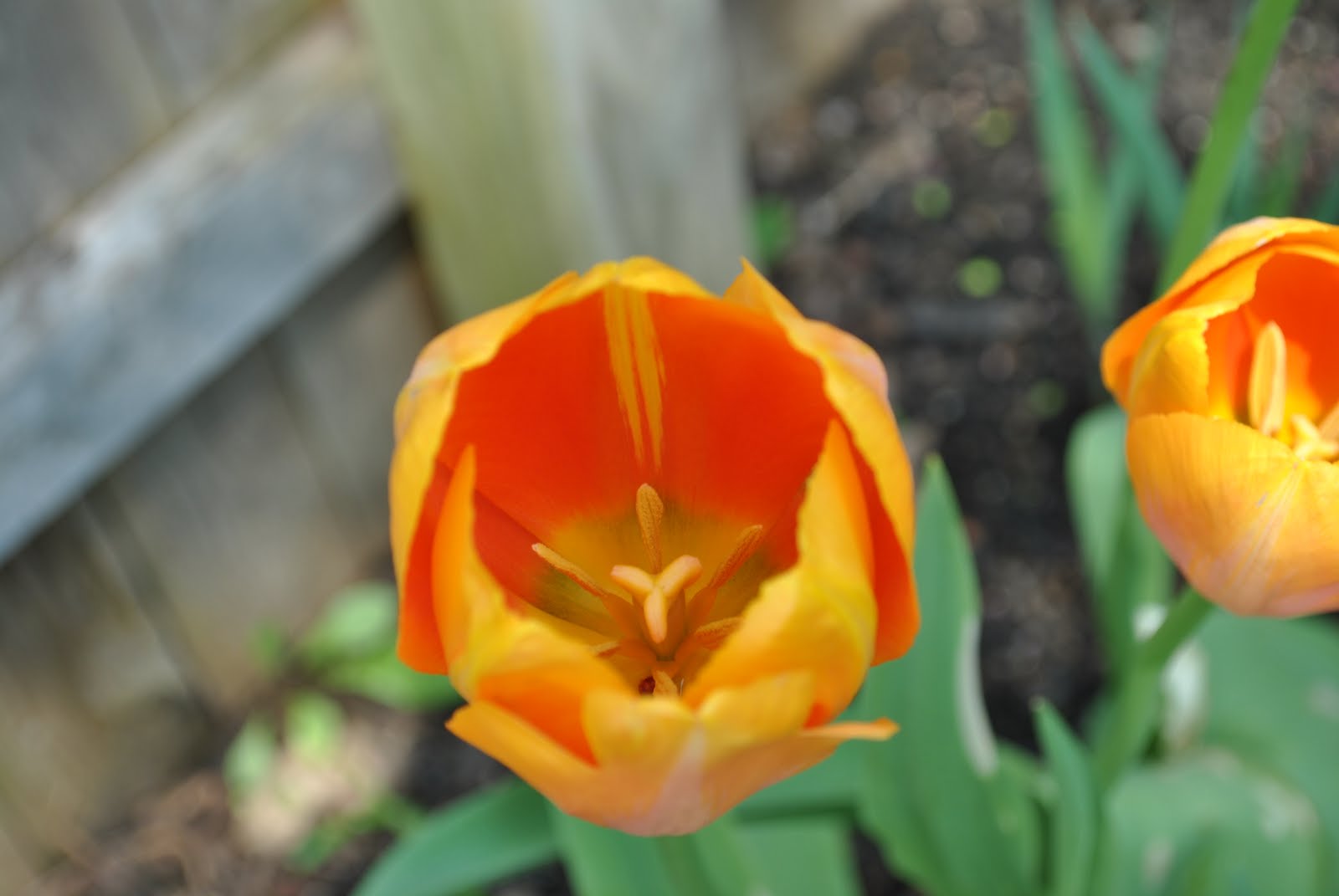
The 'Dordognes' are a little more orange than I would have liked, but when you look close you can see gorgeous brush strokes of pink and apricot:


Even the inside of these tulips is artistic:


To enjoy more flowers visit Carol at May Dreams Garden, who hosts Garden Blogger's Bloom Day every month.

Also blooming but not pictured: hellebores, variegated Solomon's seal, violets, un-named tulips.

Friday, May 13, 2011

How Not to Plant Tulips


Like this...in a long line rather than in a concentrated clump.

These tulips came with the house, so I am not actually responsible for this (although admittedly I haven't done anything about it for five years, so maybe I'm an accessory to plant design-acide).

But no longer! This is the year I dig these up and move them to the bed where I have massed tulips (and plan to mass more Darwin varieties so I don't have to do this every fall). But how should I move them? Or more specifically, when?

I would prefer to dig them up now once they've finished flowering because I know where they are. If I wait until the fall their foliage will be long gone and I'll be digging blindly.

Of course I could mark them with plant markers, but then I'll have marker sticks randomly around my garden all year. And they could get ruined by fall anyway. If the severe storms we had earlier this week happen with any sort of frequency I wouldn't be at all surprised to have plant markers washed away.


Has anyone out there successfully moved tulips post-flowering? Will I kill the bulbs if I do that? Feel free to leave suggestions!

Pictured at left, front to back: 'Dordogne', 'Negrita', 'Rembrandt's Favorite', one 'El Cid' and an un-named yellow variety.

You May Also Like

Related Posts with Thumbnails